
Chapel Hill Mixed-Media Artist Chieko Murasugi
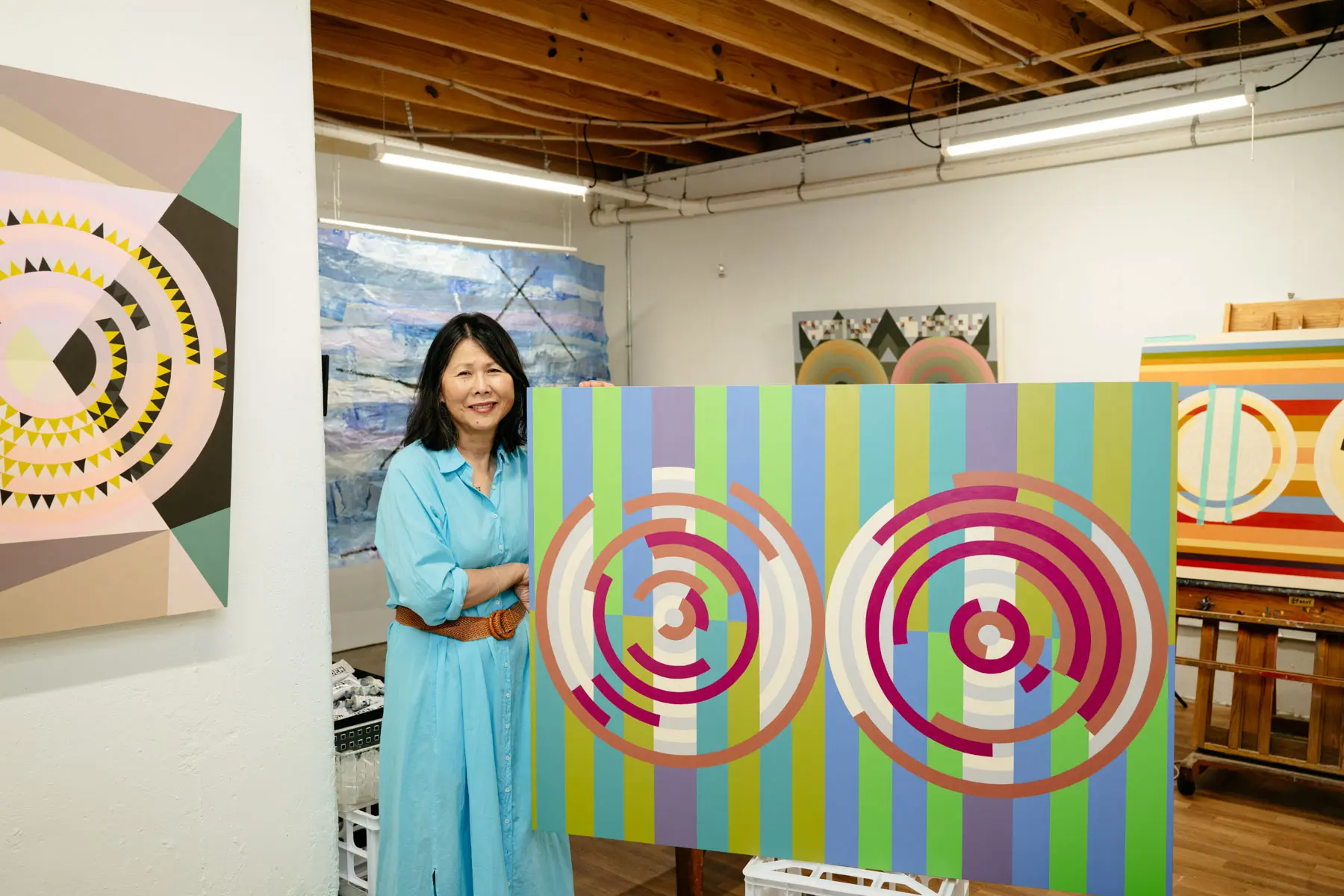
For mixed-media artist Chieko Murasugi, art begins with curiosity. She is drawn to contradictions, unexpected pairings and visual puzzles – elements that challenge assumptions and invite viewers to look closer. Whether she’s working with paint, textiles or photography, the Chapel Hill-based artist creates work that balances surprise with meaning, often exploring deeply personal and societal themes through unconventional materials.
After years of raising her two children while working largely in isolation, Chieko found something transformative in the Triangle: community. Renting her first studio outside the home connected her with fellow artists, and in 2019 she returned to school to pursue an MFA in studio art at the University of North Carolina at Chapel Hill, decades after earning her BFA.
“Living and making art in the Triangle has been rewarding beyond my expectations,” she says. Chieko’s multidisciplinary practice reflects a life that spans cultures, professions and histories. Born in Japan, she identifies as Japanese-Canadian-American. She is both scientist and artist, and the daughter of parents who survived the firebombing of Tokyo during World War II.
By Morgan Cartier Weston | Photography by John Michael Simpson
Her advice to young artists is to lean into their personal background as a source of inspiration. “There might not be another American with your particular history,” she says. “These experiences will become your art.”
Her work frequently combines beauty and discomfort, joy and sorrow. A quilt inspired by the traditional log cabin pattern incorporates images of bullet casings to address gun violence in the United States. A kimono constructed from cheesecloth and rabbit-skin glue references the napalm bombs dropped on Tokyo. Another, sewn from donated bras, celebrates womanhood.
“I am attracted to unusual combinations because my own history and identity are multifaceted,” she says.
Although painting was her first artistic medium, Chieko can’t choose a favorite. Instead, she embraces experimentation. Photography allows her to capture surprising moments as they happen, while textiles and painting provide opportunities to explore ideas through material and process.
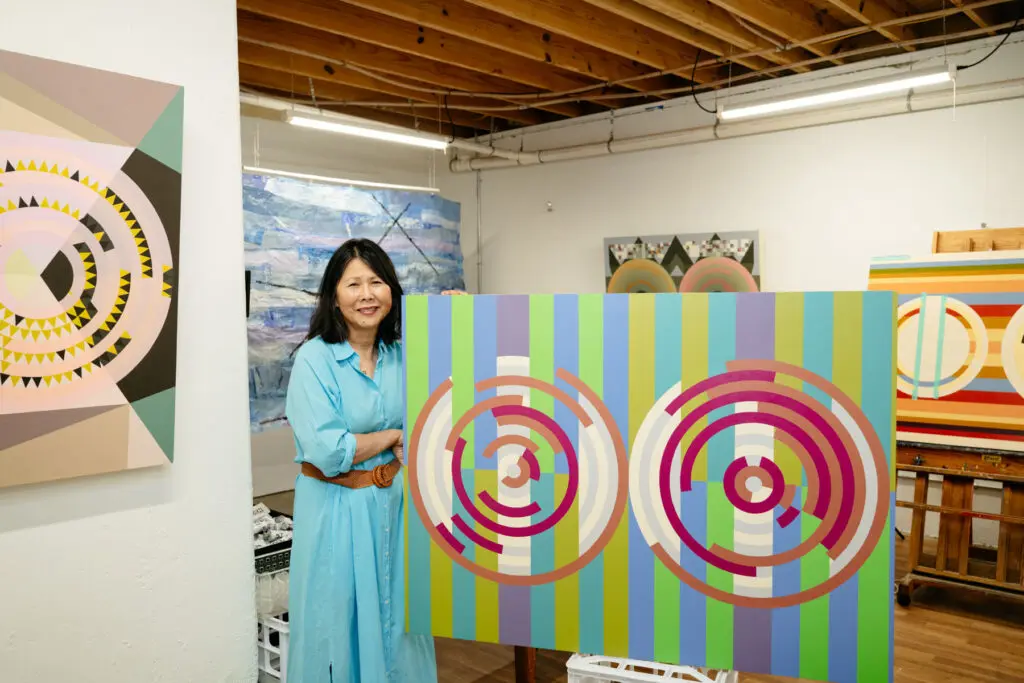
One of her ongoing projects, the “Deuce” painting series, uses identical chance operations in paired circles to demonstrate how dramatically outcomes can differ despite the same set of rules. “It’s unexpected that random choices can produce such geometric abstraction paintings,” she explains.
The series was recently exhibited at Durham’s Craven Allen Gallery, where visitors can continue to view and inquire about her work. After presenting two major exhibitions this spring – including a mid-career retrospective at GreenHill Center for NC Art in Greensboro – Chieko is looking forward to a quieter season focused on creating. Future projects include kimonos made from old diary pages and the American flag, continuing her exploration of memory, identity and cultural complexities: “In my art, I find coherence when possible but let tensions remain.”
Community-Driven Durham Muralist Gabriel Eng-Goetz
Community is more than inspiration for muralist Gabriel Eng-Goetz – it’s his medium.
“Despite jumping around different materials, locations and messages, the commonality in my murals has always been community,” he says. Born and raised in Durham, Gabriel studied art at Syracuse University before living and working in other states and countries – yet he always found himself drawn back home. “Durham is a very special place and has always been good to me,” he says. “I just really, really love it.”
Today, his large-scale murals can be found across North Carolina and beyond, often created through an extensive process of research, listening and collaboration. Before putting pencil to paper, Gabriel immerses himself in the history and identity of that place.
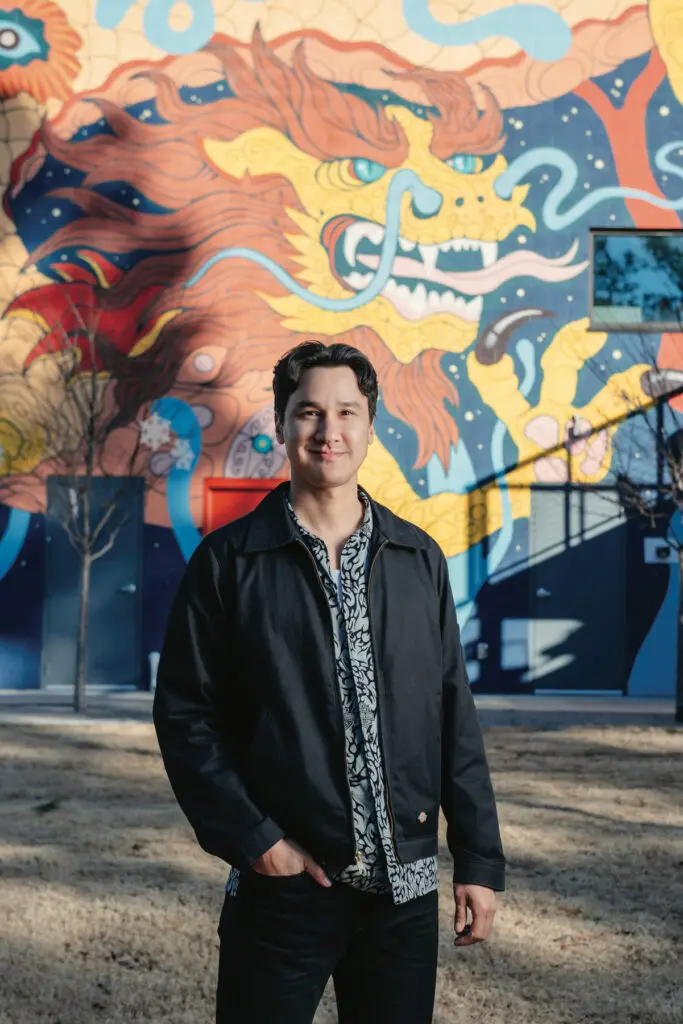
“I’ll often go in for several days and visit historical sites and talk to people,” he says. “I try to understand the theme, vibe, history and cultural identity of the area.”
That research becomes the foundation for murals that celebrate place while inviting viewers to discover deeper layers of meaning. His work frequently explores humanity’s connection to nature, a theme that resonates strongly with the areas he serves.
“The number one request I get when I’m engaging a community is nature,” he says. “People obviously love the outdoors, but as we delve further into the technological abyss, people are wanting to feel that connection more and more.”
Bright colors, flowing forms and organic imagery have become signatures of Gabriel’s work. While visually striking from a distance, his murals often contain subtle references and symbolic details for local residents to uncover.
“I don’t want to hit people over the head,” he says. “I want people to delve into the details and the subtle symbolism.”
Creating public art, however, is far from glamorous. “I think people really romanticize painting murals as a career, but it is hard, blue-collar work,” he says. Long days on lifts, extreme heat and physical exhaustion are part of the job, yet the rewards make the effort worthwhile.
“There are times when the weather’s great, maybe you’re in the shade, it’s golden hour and you can see the sum of all your labor as this giant piece comes together,” he says. “It’s a unique moment of Zen.”
This year also marks a new chapter for Gabriel with the launch of Durm Studio, a revival and evolution of the Runaway brand he previously operated. Alongside business partner Michael Brannon, Gabriel plans to offer apparel design, custom merchandise production and creative services while continuing his public art practice.
And, after spending years traveling from project to project, he’s excited to reconnect with the city that shaped him. “I missed having a steady connection to Durham,” he says. “I’m hoping Durm Studio allows me to experience the Durham arts and business environment the way I have in the past.” For an artist whose work is rooted in place, it’s a fitting homecoming.
Raleigh Visual Artist Leslie Pruneau
Leslie Pruneau doesn’t consider herself a landscape painter. The Raleigh artist paints forests, rivers, oceans and fields of wildflowers, but for her, the subject is never simply a place. Instead, it’s a reflection of an inner world. “I feel I am painting an emotional landscape as much as a physical one,” she says.
A Raleigh native and graduate of East Carolina University, Leslie has been on an artistic journey that has taken her far beyond North Carolina. After college, she moved to New York City before traveling through Europe, where a planned one-week stop in Berlin coincided with the fall of the Berlin Wall.
“There was so much energy after the wall came down,” she recalls. It captured Leslie’s imagination, and she ultimately spent years living between Berlin and New York before returning to the Triangle when her husband accepted a position in Research Triangle Park.
The region she came home to looked very different from the one she left. “When I came back, I was pleasantly surprised to see how much the arts had changed throughout Raleigh, Durham and Chapel Hill,” she says. “There is so much room for creative exploration now in the Triangle.”
Having an affordable studio outside her home has further transformed her practice. Today, she works daily from her space at Artspace, creating richly textured oil paintings built from layer upon layer of paint – sometimes hundreds.
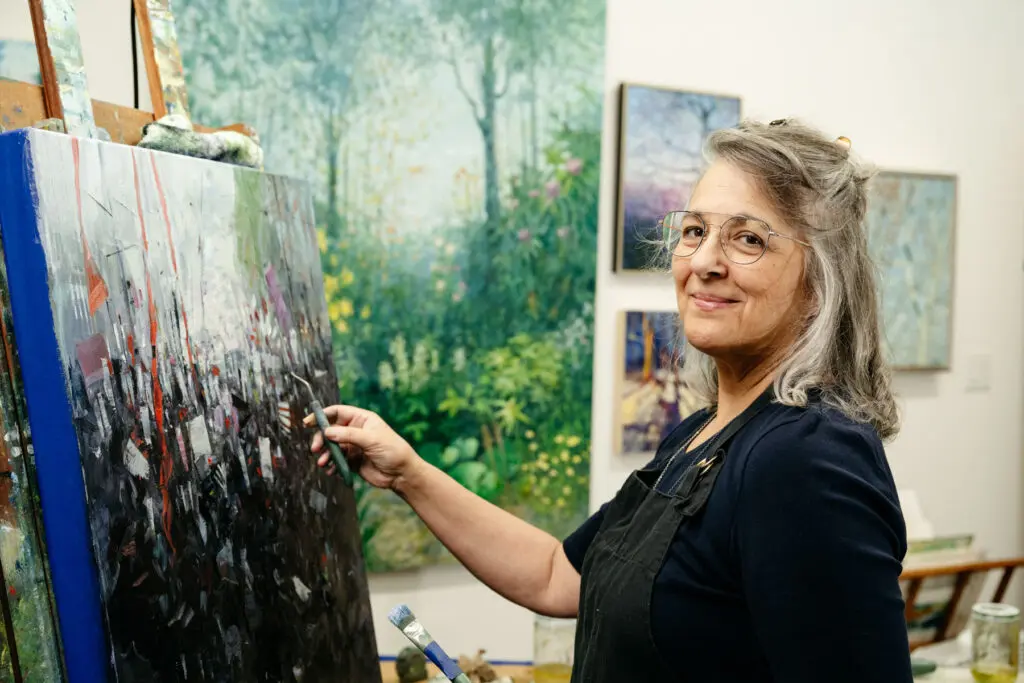
“I’ve been painting for 40 years,” she says. “It’s always intrigued me – how far can I build [the paint] away from the plane?”
Her paintings often begin outdoors. An avid hiker and cyclist, Leslie spends time observing nature, searching for moments that resonate emotionally. Photographs serve as references but are not interpreted literally.
“I’m trying to capture the feeling of that place, not always the exact image,” she says. During the pandemic, Leslie shifted away from conceptual and socially focused work toward paintings inspired by the resilience of the natural world. Trees, flowers and ecosystems became metaphors for human experience.
“I wasn’t seeing people, and I switched to a narrative of using nature to describe my feelings and emotions,” she explains.
More recently, Leslie has found herself thinking about crowds as well as landscapes. Fields of wildflowers and gatherings of people, she says, share a common desire: “A large group of many individuals, each wanting to be seen and heard.”
A longtime educator, Leslie has taught at institutions including Pullen Arts Center, Artspace and the North Carolina Museum of Art, and is passionate about helping others discover creativity. However, her own studio practice now occupies most of her time. “Making art is so important to me,” she says.
“Just like life, there is a path behind everything [artists] do,” she says. “Even though no one may ever see the splash of yellow hidden under the layers of paint, it’s there, and it is part of the painting.”
Leslie Pruneau
Visitors can find her work during Raleigh’s First Friday events at Artspace and in upcoming exhibitions, including a summer landscape show at Frank Gallery in Carrboro. And if viewers look closely, they may discover one of her favorite hidden details – a bee or bird tucked quietly into the scene. After all, she says, “Good art isn’t just there to be looked at. Good art looks back at you.”
Want to get creative this fall? Explore our autumn arts guide to the Triangle!
